
Turn, lift, and spin
Disc golf physics: June 30, 2022

Lift and spin
If you've ever thrown a golf disc or a frisbee, you know that it's hard to make them go dead straight; they want to go left or right at different times during their flight. (And sometimes they wobble.) All of that is due to lift and spin interacting with each other. If you learn how to control that interaction, you may become an amazing disc golfer!
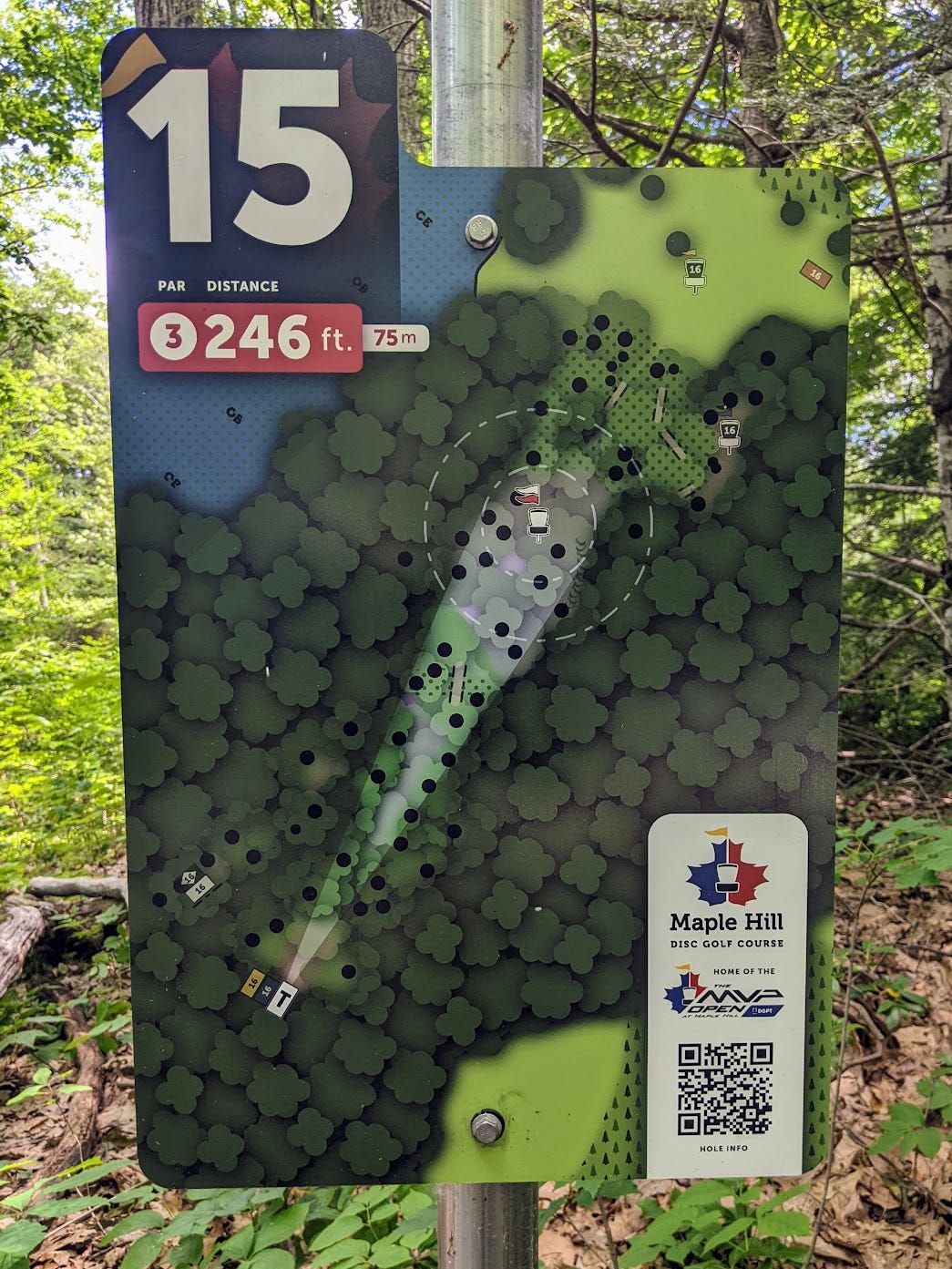
Here’s a hole where you want to minimize both early turn and late fade, otherwise you will end up in the woods:
Before we get into the gory physics of disc flight, here's the bottom line: turn is directly proportional to lift and inversely proportional to spin:
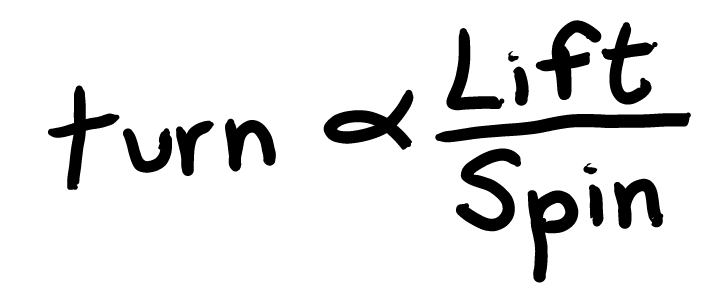
Practically speaking, this means that the faster the disc moves (hence more lift), the more it turns. Also, the more it spins, the less it turns. More briefly:
More airspeed = more turn
More spin = less turn
That's why Calvin Heimberg and Page Pierce (and every other professional disc golfer) can throw drivers designed for high speeds and get them to turn, while for me they just hang a hard left turn and dive into the ground. They can actually throw high-speed discs at their high design speeds. I cannot, so I throw mostly midrange discs or fairway drivers off the tee.
The wing and the gyroscope
Because a flying disc is both a wing and a gyroscope, its two most important dynamic characteristics are lift (that's the wing part) and spin (that's the gyroscope). Lift keeps the disc aloft, and spin keeps it (relatively) stable while flying. However, it is the interaction of lift and spin that makes things interesting! To explain why this happens, we'll need to explain some physics, including force, torque, axes, and angular momentum. Stay tuned!
The whole disc golf illustrated series (so far):
Turn, lift, and spin (this post)